


Personal Finance tips for the broke: because you probably won't win that lottery!
- Vibhu Agarwal
- Dec 29, 2023
- 4 min read

"It's not how much money you make, but how much money you keep, how hard it works for you, and how many generations you keep it for."
- Robert Kiyosaki
Reaching at the top is only half the battle won. Next challenge is remaining at the top. Mr. Sushil Kumar (Winner KBC - 2011) went Bankrupt in the year 2015.

We are asked to believe that ‘There is only one way to make money, and that is through a business of your own?’
But a lot of us are not in condition to start something of our own right away. We may have a family to support financially, or we simply just don’t want to do something of our own.
But does that mean we won’t be able to make big money?
I've been wondering the same, so read a lot about it and came to 4 basic steps of personal finance that everyone has to follow.

We all are going to become Chartered Accountants very soon and will start earning, one way or the other. How we use that money, right from day 1 will decide, how wealthy or broke we get 20 years down the line.
The 4 rules of Personal Finance, if followed religiously, can give you a sense of financial security at a very early stage of your career, help make you more money and at the end of the day will lead to a carefree good night sleep.

Step 1: Make an Emergency Fund
An emergency fund should be corpus of money equal to 6-8 months of your monthly expenses parked in a highly liquid form like Bank Deposits.
It is necessary because:
Protection Against Unforeseen Expenses:
Life is unpredictable, and emergencies can arise at any time, such as medical bills, unplanned car, or home maintenance.
Emergency fund ensures that individuals and families can cover these unexpected expenses without disrupting their financial stability.
Prevention of High-Interest Debt:
Having cash readily available helps prevent the accumulation of expensive debt and the associated financial stress.
Cushion During Job Loss or Income Interruptions:
In the event of job loss or a temporary interruption in income, an emergency fund provides a financial cushion. Millions of people lost their sources of income during Covid Lockdowns. We now know better than ever, that how important it is to be ready if we are laid off.
It allows individuals to meet essential expenses while actively seeking new employment or addressing the circumstances causing the income disruption.

Step 2 : Get a Medical Insurance
Medical insurance for you and your family is the next important step. Having a medical insurance provides following advantages:
Rising Healthcare Costs:
Medical Inflation in India is roughly 14%.
70% Indians are one medical bill away from falling into poverty.
Medical insurance helps individuals and families mitigate the financial burden associated with expensive medical treatments and hospitalization.
Access to Quality Healthcare:
Insurance plans often include cashless hospitalization, making it more convenient for policyholders to receive timely and quality medical care.
Tax Benefits:
Contributions made towards health insurance premiums are eligible for tax benefits under Section 80D of the Income Tax Act.
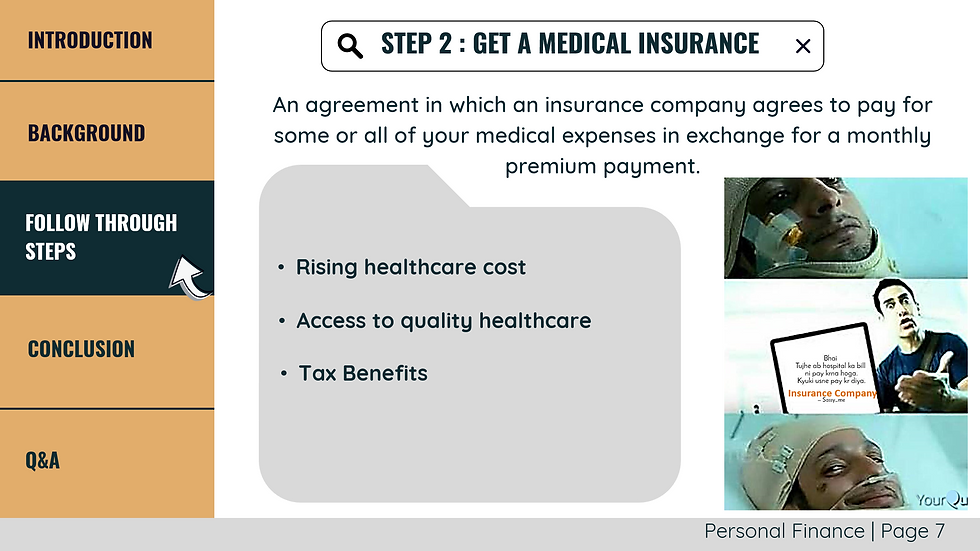
"Inspite of 206 broken bones, Raju Rastogi is smiling because his insurance company covered the hospital bill"
Step 3: Get a Term Insurance
A legally binding contract between the insured and the insurer where a death benefit is provided to the beneficiary if the insured dies during policy tenure.
These are specially necessary for families with single bread earners.
Financial Protection for Dependents:
Term insurance provides a financial safety net for dependents in the event of the policyholder's untimely death.
The death benefit can be used to replace lost income, cover living expenses, and maintain the financial well-being of surviving family members.
Affordable Premiums:
These offers more affordable premiums compared to other types of life insurance.
This affordability allows individuals to secure a higher coverage amount for a relatively lower cost.
Debt Repayment:
Term insurance can be used to cover outstanding debts, such as mortgages, loans, or other financial obligations.
It prevents the burden of debt from passing on to family members in the event of the policyholder's demise.
Education and Future Expenses:
The death benefit can be earmarked to cover educational expenses for children, ensuring they have the financial means to pursue their academic goals.
It can also fund other future expenses, such as weddings or major life events.

Step 4: Save and Invest
Only saving money is not enough. If we are not investing it, it will lose value with time. Saving and investing is the 4th step. Here is why you should do it:
Wealth Accumulation:
Investing provides the opportunity for wealth accumulation over time.
By putting money to work through various investment vehicles, individuals can potentially generate returns and see their wealth grow.
Beat Inflation:
Inflation erodes the purchasing power of money over time. Investing offers the potential for returns that can outpace inflation.
By earning returns that exceed the inflation rate, investors can maintain or increase their real wealth.
Even if you know nothing about it and are not interested to learn, just start a monthly SIP with an Index. Let me give you an example:
A monthly investment of Rs 2500 with an annual step up of 10% done for 38 years (till the time I am 60) and with a very conservative expected return of 11% makes total of Rs. 1,09,21,303 invested compound to Rs, 5,41,56,565.
You can play with variables here and come up at your number - https://groww.in/calculators/sip-calculator
Conclusion
‘Money may not be the reason for happiness, but having money makes the world a hell lot easier place to live in.’ - Shah Rukh Khan
First three steps, ie. making an emergency fund, getting a medical insurance, getting a term insurance gives you and your family a safety net against few uncertain things that might go wrong.
Fourth step ie. Saving and Investing will make your money work for you and eventually make a corpus, that will help you during your bigger expenses like your child’s higher education, buying a house or earlier retirement.
These points are so important, yet we were unaware of it. We are taught how to earn money, but are never told how to use it properly. I hope these tips and tricks turn out to be fruitful for you.

Comments